

Vous êtes ici : SECT UNESCO > Vieux-Lyon > Quartier St-Paul > L'e Palais de Bondy
LE PALAIS DE BONDY
With the aim of rebuilding the Saint-Paul district, the City Council decided at the end of the 19th century to erect a monumental building on the banks of the Saône, on the site of the former Customs Square that had been built there in 1553.
Description of the Building
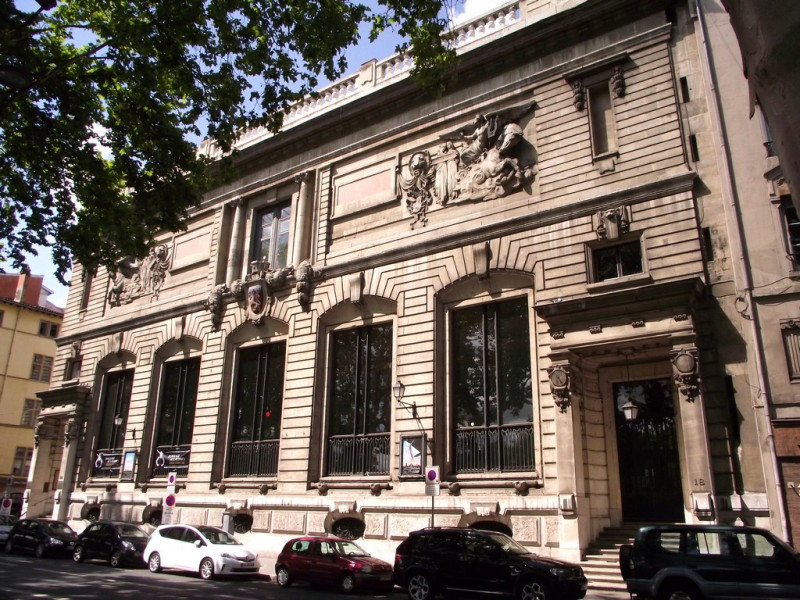
The purpose of the construction was to house the Conservatory, which at the time had no place dedicated to its activities, and exhibition rooms. It was built between 1902 and 1904. The architect Eugène Huguet was in charge of the work. This project included a group of buildings stretching from the rue de l'Angile to the Quai de Bondy, where an imposing body of buildings has two entrances with a semicircular porch opening onto a vast 52 m2 vestibule, with a ceiling decorated by the painter Louis Bouquet, which leads to the different levels of the concert hall, called the Salle Molière. On the first floor there are two exhibition rooms.
Its large façade is pierced by five large bay windows. It is surmounted by a cornice with a balustrade and two bas-reliefs by the sculptor Thomas Lamothe symbolising Music, Painting and Sculpture, with in the centre a cartouche with the coat of arms of the City of Lyon.
On the façade facing rue Pierre Carrand, a surface in unworked stone indicates the place where a high relief was to be sculpted to honour Molière who had settled with his troupe in Lyon. It was probably between 1652 and 1655 that he met the Italian actors and the Commedia dell'arte.

He composed his first scenarios and probably wrote the Etourdi which he would have played for the first time, in 1655, in the Jeu de Paume, now destroyed, which was situated on this site. For lack of means, the work of the Sculptor Ploquin could not be realized.
During the war, the explosion of the Pont de la Feuillée bridge in 1944 damaged the Palais de Bondy. The damage was significant. The sculptures were hit, the façade was riddled with bullets, the windows were shattered and the glass roof over the Molière room collapsed. Major restoration work was necessary and the new hall was inaugurated in 1951.
The Moliere Room
Originally, the Salle Molière could accommodate nine hundred spectators spread over several levels, including a parterre, dressing rooms, amphitheatre and gallery. The decoration of the hall is by Louis Bardey and that of the stairs leading to the exhibition rooms is by Alexandre Baudin. It was originally inaugurated in 1912. After the torments of the war and the damage caused, it only had seven hundred seats.
Thanks to its excellent acoustics, this hall remains one of the most appreciated in Lyon by music lovers, and according to some, one of the best chamber music concert halls in France.
The Exhibition Halls
Located on the first floor of the building, the Grand Salon, with a surface area of 395 m2 and the Salon à Rotondes of 150 m2, as well as two other small lounges of 40 m2 are open to different activities such as exhibitions, trade fairs, conferences, etc.
The large halls are equipped with picture rails, reception furniture and electrical equipment. These rooms are subject to the safety regulations applicable in establishments receiving the public and are managed by Lyon's central city council.
The Guignol Puppet Theatre
This Guignol theatre, installed in the basement, has its entrance at 2, rue Louis Carrand. It is now home to the Compagnie Ma, to whom the city has entrusted the development of the municipal theatre. Created in June 2010 on the initiative of Emma Utges, actress, singer and puppeteer, the Compagnie M.A. originally had a dream: to create shows that would bring together actors, musicians, puppeteers, lighting designers, stage managers, set designers, visual artists... A modest vocation if it were not accompanied by a formidable requirement, that of promoting contemporary puppetry. https://www.guignol-lyon.net
